Updated 08.01.25 with Rules Committee links, and social media graphics!
Bayer, after acquiring Monsanto in 2018, has faced over 170,000 lawsuits alleging that Monsanto’s Roundup herbicide, containing glyphosate, causes cancer, particularly non-Hodgkin’s lymphoma. These lawsuits, costing Bayer billions (including a $10.9 billion settlement in 2020), have prompted the company to lobby for immunity from “failure-to-warn” claims through state and federal legislation.
These claims assert Bayer/Monsanto failed to adequately warn users of health risks despite evidence, like the 2015 IARC classification of glyphosate as “probably carcinogenic.” Bayer argues that compliance with EPA-approved labels, which don’t warn of cancer risks, should shield them from liability, as the EPA deems glyphosate safe.
Critics, including farmers, cancer survivors, and advocacy groups, argue this legislation prioritizes corporate interests over public health, limiting victims’ rights to seek justice, especially given allegations (e.g., Monsanto Papers) that Monsanto hid evidence of harm.
Groups like Pesticide Action Network, Iowa Farmers Union, and Stand for Health Freedom, alongside farmers and cancer patients, argue these bills undermine accountability, especially given evidence Monsanto manipulated studies and withheld data (e.g., changing Roundup’s formulation in the EU but not the U.S.). Iowa’s high cancer rates and cases like a farmer’s daughter dying from pesticide-related birth defects fuel resistance.
Special Streams:
- “Seeds of Death: Unveiling The Lies of GMO’s ” 2013 Documentary
- “The Killing Fields by Big Agriculture & Big Pesticide” Mini Movie Marathon
Bayer’s Strategy
· State-Level Lobbying: Through the Modern Ag Alliance, a coalition of over 90 agricultural stakeholders, Bayer has pushed for state bills granting immunity from lawsuits if pesticide labels comply with EPA regulations. These bills aim to preempt state-level “failure-to-warn” claims under the Federal Insecticide, Fungicide, and Rodenticide Act (FIFRA). Tactics include extensive advertising (billboards, mailers), alliances with agricultural groups (e.g., Iowa Soybean Association, Missouri Corn Growers), and framing the legislation as protecting farmers’ access to glyphosate, claiming lawsuits could lead to its market withdrawal (a claim critics call a scare tactic).
· Federal Efforts: Bayer is advocating for the Agricultural Labeling Uniformity Act to be included in the U.S. Farm Bill, which would establish uniform pesticide labeling nationwide, preempting stricter state laws and shielding companies from lawsuits if EPA label requirements are met. They also support a petition by 11 Republican-led state attorneys general to reinforce EPA authority over labeling and have asked the U.S. Supreme Court to rule on whether federal law preempts state lawsuits alleging failure to warn about cancer risks, citing a 2005 Supreme Court ruling (Bates v. Dow Agrosciences) that currently allows state claims despite EPA approval.
· Tactics:
-Bayer has allied with agricultural groups (e.g., Iowa Soybean Association, Missouri Corn Growers), used extensive advertising (billboards, mailers), and employed lobbyists to frame the legislation as protecting farmers’ access to glyphosate, claiming lawsuits could lead to its market withdrawal (though critics call this a scare tactic).
-“A central figure for the industry in this plan is House Agriculture Committee Chair Rep. Glenn Thompson (R‑PA). According to Open Secrets website, Rep. Thompson received $602,355 in campaign contributions in 2023-24 from the crop production and basic processing sector, in addition to the agricultural services and products sector. He recently acknowledged that not everyone would share his opinion about two key provisions that are on his agenda for the upcoming Farm Bill which stand to directly benefit his major campaign contributors:
1. The proposal that pesticide companies would gain legal immunity from lawsuits as long as their products adhere to federal EPA labeling guidelines.
2. The Food Security and Farm Protection Act (S.1326), a repackaged version of the EATS Act (Ending Agricultural Trade Suppression Act),would override state-level animal welfare and chemical-use standards, effectively stripping states of the power to impose stricter standards.”
THE FEDERAL CALL TO ACTION!
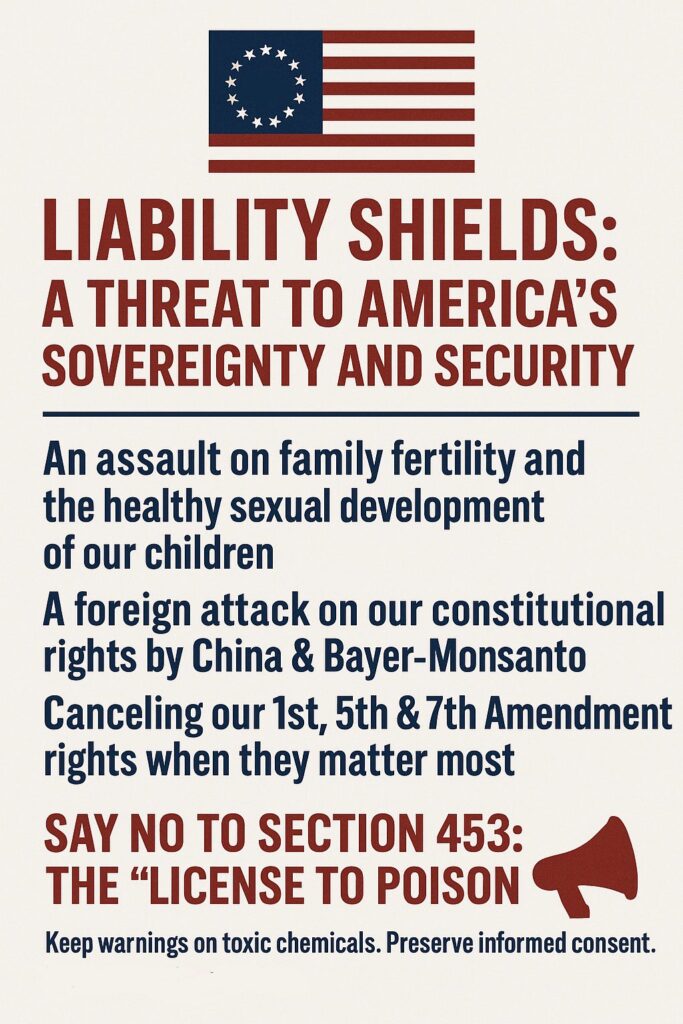
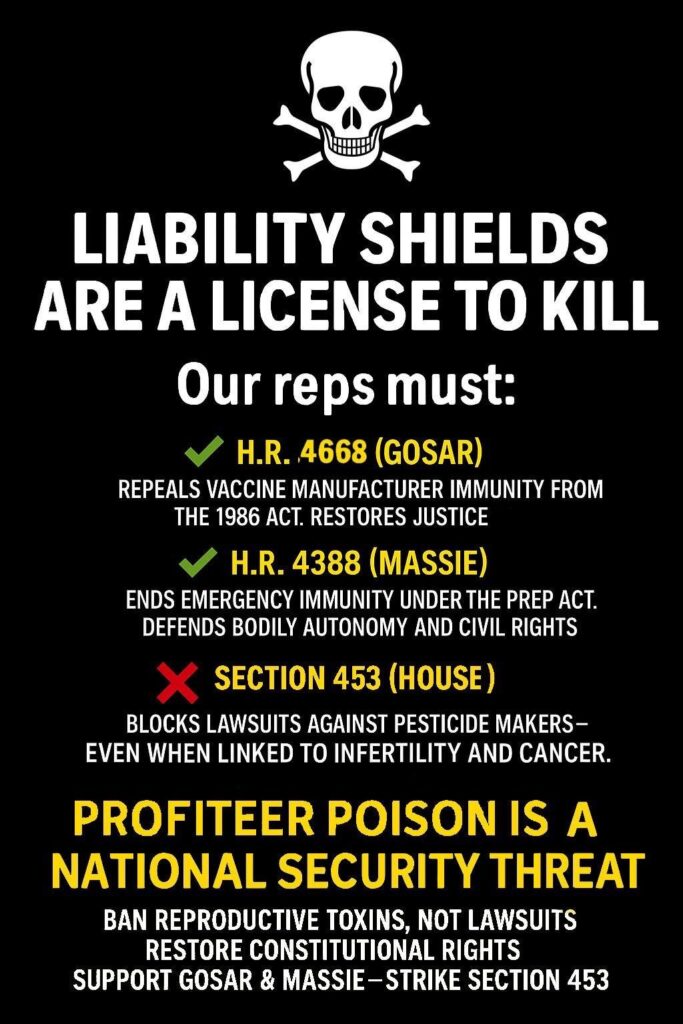
URGENT – Section 453 of the Federal House Interior Appropriations bill
has Pesticide language included in it which WILL give them immunity.
Various attorneys and policy analysts confirmed this – do not let the politicians and pundits convince you otherwise!
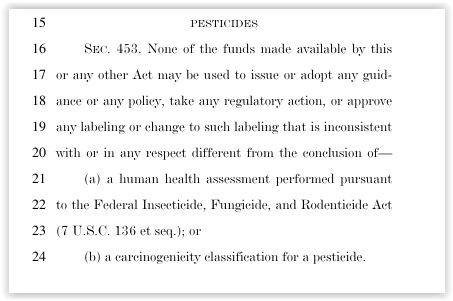
If passed, the EPA would effectively be frozen in time and prevented from reviewing and doing its job as it relates to pesticides, herbicides, etc.
It would also immediately impede the 67,000 pending lawsuits claiming Monsanto-Bayer Roundup caused cancer.
It passed the Appropriations Committee – next stop is the House Rules Committee!
Please Call/Visit the following members – they are in their Districts the month of August!
For all House members: FULL CONTACT LIST of HOUSE REPS, includes X Handles!
Curated CTA Thread
Sample letter to email or Post on X:
(if on x add your Rep’s account tags in addition to the members above X account.
To: XXXXX
Re: Formal Objection to Section 453 – FY 2026 Interior, Environment, and Related Agencies Appropriations Bill
Dear Chairman Cole and Members of the Committee:
I write to formally object to the inclusion of Section 453 in the FY2025 Interior Appropriations Bill, which grants legal immunity to pesticide manufacturers. This provision constitutes a legislative rider that introduces new substantive law unrelated to the underlying purpose of the appropriations bill.
Appropriations bills are meant to allocate funding — not to amend liability laws or shield corporations from legal responsibility. This rider:
Is not germane to the Interior Department’s operations or budgetary authority;
Falls under the jurisdiction of the Agriculture, Commerce, and Judiciary Committees, not the Interior Subcommittee;
Bypasses committee process, debate, public input, and expert testimony;
Sets a dangerous precedent by using appropriations to make significant policy changes.
Regardless of one’s position on the underlying liability question, the appropriate venue for this debate is in authorizing legislation, not a must-pass funding bill.
I respectfully request that Section 453 be removed in its entirety prior to floor consideration.
Sincerely,
We The People!
Graphics for Social Media:
States with Passed Immunity Legislation
Two states have enacted Bayer-backed pesticide immunity laws:
1. Georgia – Status: Signed into law by Governor Brian Kemp in May 2025, effective January 2026. – Details: Prevents lawsuits against pesticide producers for failing to warn of health risks beyond EPA requirements, despite a $2.1 billion Georgia jury verdict in 2025 linking Roundup to cancer.
2. North Dakota – Status: Signed into law by the governor in April 2025. – Details: Protects pesticide companies from liability for EPA-approved labels, passed with no opposition in the House.
States with Pending or Failed Bills
Bayer’s efforts have met resistance, with bills introduced in at least 20 states in 2025, many failing due to grassroots opposition. Below are states with notable activity:
1. Iowa: – Senate File 394 (SF 394), previously Senate Study Bill 1051 (SSB 1051). – Senate File 2412 (SF 2412) (2024, similar intent). – Status: SF 394 passed the Senate (26-21) in March 2025 but stalled in the House. SF 2412 passed the Senate in 2024 but was not taken up by the House. As of May 2025, the bill remains stalled. – Details: Shields pesticide makers from “failure-to-warn” lawsuits if labels comply with EPA rules. Critics, including Iowa Farmers Union, argue it limits farmers’ legal recourse, especially given Iowa’s high cancer rates.
2. Tennessee: – Senate Bill 527 (SB 527). – House Bill (sponsored by Rep. Rusty Grills, no specific number provided). – Status: SB 527 passed the Senate Judiciary Committee in March 2025, but the House Judiciary Committee postponed the legislation to 2026 after concerns from stakeholders. – Details: Grants immunity to pesticide manufacturers for EPA-approved labels, criticized for stripping constitutional rights to jury trials.
3. North Carolina: – Bill: Immunity language was added to the NC Farm Act of 2025. – Status: Pending as of May 2025, with the Senate Judiciary Committee scheduled to review. – Details: Limits pesticide liability, part of Bayer’s broader campaign, facing opposition from public health advocates.
4. Missouri: – Bill: Sponsored by Rep. Dane Diehl (# ?) – Status: Passed the House in April 2024 but died in the Senate by May 2025 due to bipartisan opposition, including from the Freedom Caucus, citing violations of Seventh Amendment rights. – Details: Would protect Bayer from lawsuits over EPA-approved labels, despite a $611 million Missouri judgment against Bayer.
5. Idaho: – Bill: Not explicitly numbered, but matched Iowa’s legislation. – Status: Died in committee in 2025. – Details: Pushed by Bayer, who operates a glyphosate plant in Soda Springs, but faced opposition over limiting accountability.
6. Florida: – Bill: Not explicitly numbered, but referenced as advancing in the House Civil Justice & Claims Subcommittee. – Status: Pending as of April 2025, moving through committees. – Details: Aims to protect Bayer from Roundup-related lawsuits, opposed by activists citing cancer risks.
7. Other States with Failed Bills (2025 session): – Montana, Wyoming, Mississippi, Oklahoma. These states rejected immunity bills due to public and advocacy group pressure.
Note: Bayer has vowed to reintroduce bills in these states in future sessions.
Summary
Bayer/Monsanto’s immunity push is a response to costly Roundup litigation, using state and federal channels to limit “failure-to-warn” lawsuits. Georgia and North Dakota have passed such laws (SB 144 in Georgia), while Iowa (SF 394), Tennessee (SB 527), North Carolina (NC Farm Act), Florida, and others have pending or recently failed bills. Opposition highlights public health and legal rights, slowing Bayer’s progress in most states.
Sources:
- The Bayer-Monsanto Protection Act on Steroids is Being Considered in the Backrooms of Congress
- Open Secrets
- Thompson eyes stand-alone farm bill despite budget uncertainty
- Beyond Pesticides State Bill Tracker
- Pesticide Action Network
- Civil Eats
- Tennessee Lookout
- Investigate Midwest
- Bleeding Heartland
- AgriNews
- Beyond Pesticides Daily News Blog
America Mission™: MAYM
We are researching….
We are talking TRUTH…
We have discovered your LIES…..
WE KNOW WHAT YOU ARE DOING!!!!




Hearing 09.10.25 https://www.youtube.com/live/kB2zq7ykPTg?si=5J0Y6qBEt0f6iH3-