
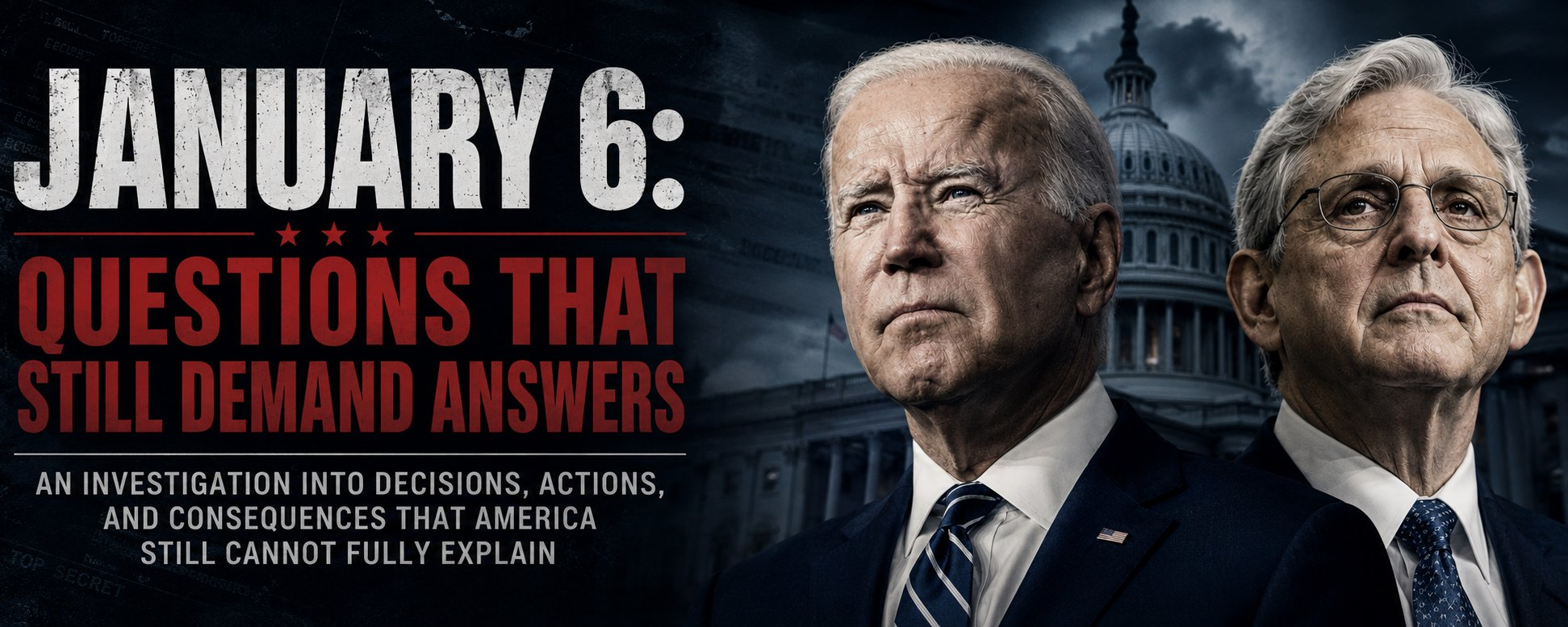
How can the largest security failure at the Capitol in modern history occur when warnings existed beforehand?
That is the question that lingers long after the footage, the hearings, and the headlines.
The most important unanswered question about January 6 may not be what happened on that day. It may be how the government chose to respond afterward.
January 6 involved real violence. Police officers were assaulted. Property was damaged. Congress was disrupted. Individuals who committed crimes should be held accountable.
But accountability cuts both ways.
When government exercises extraordinary power, citizens are entitled to ask extraordinary questions.
The purpose of this article is not to relitigate January 6.
It is to ask questions that remain unanswered years later.
Questions about intelligence.
Questions about preparation.
Questions about tactics.
Questions about proportionality.
Questions about accountability.
And questions about the precedents established in response to a single day that continue to shape the relationship between citizens and their government.
I. The Warnings
How does a breach of this scale happen when intelligence pointed directly at the threat?
Former Capitol Police Chief Steven Sund has repeatedly stated that the attack was preventable. According to Sund, intelligence existed regarding potential violence, threats against lawmakers, and efforts to breach the Capitol. He requested National Guard support before January 6.
The request was denied.
On January 6 itself, additional requests were delayed while events unfolded. Public warnings existed. Open-source intelligence existed. Social-media discussions existed. Law-enforcement assessments existed.
Yet the information did not translate into preparation.
Why?
Who received the warnings?
Who did not?
What information reached decision-makers?
What information remained compartmentalized?
What information was considered credible?
What information was dismissed?
If the attack was preventable, what specifically prevented prevention?
And if the government possessed sufficient information to investigate thousands of participants afterward, what information did it possess beforehand?
Those questions remain central to understanding what occurred.
II. The Communication Question
If authorities believed a dangerous situation was developing, what efforts were made to communicate directly with the crowd?
This question receives surprisingly little attention.
By January 2021, government agencies possessed multiple methods of communicating with large populations: Emergency alert systems, public-address systems, broadcast media, social media, wireless emergency notifications, and geographically targeted messaging.
If officials believed the situation was deteriorating, what options were considered?
Were repeated warnings issued?
Were emergency cellphone alerts considered?
Were mass-notification systems considered?
Were social-media channels used to encourage dispersal?
Were organizers contacted?
Were prominent public figures asked to amplify evacuation messages?
If these options were considered and rejected, why?
If they were not considered, why not?
What is more likely to persuade ordinary people to leave a dangerous area than an official government warning delivered directly to the device in their pocket?
The question is not whether such measures would have worked.
The question is whether they were seriously considered.
III. The Prevention–Investigation Gap
This may be the most important unanswered question of all.
If the government could locate and arrest participants across the country within weeks, could it not have reached them beforehand?
Within weeks of January 6, investigators were identifying participants nationwide using cellphone data, social media, public videos, digital forensics, and public tips.
Within months, arrests were occurring across the country.
The Department of Justice conducted the largest criminal investigation in its history. The government demonstrated extraordinary investigative capability. Yet the same system appeared unable to prevent the breach despite warnings, intelligence, contingency planning, and advance notice of a massive gathering.
Why?
What changed between prevention and investigation?
Why did the government’s ability to investigate appear significantly more effective than its ability to prevent?
Were resources unavailable beforehand but available afterward?
Were warnings not taken seriously?
Were decision-makers operating with incomplete information?
Or did structural failures exist that have never been fully explained?
The Prevention–Investigation Gap remains one of the most important unanswered questions arising from January 6.
IV. Why Was January 6 Treated Differently?
Why did this event trigger an unprecedented federal response when other disruptions did not?
That is not a question about innocence. It is a question about standards.
The 2020 riots resulted in thousands of arrests nationwide. Police officers were assaulted. Government buildings were attacked. Federal courthouses were damaged. Businesses were destroyed. Occupy Wall Street disrupted public spaces for months. Various activist groups have occupied government buildings and interrupted legislative proceedings.
Yet January 6 became the largest criminal investigation in FBI history.
Why?
What standards governed that decision?
What factors triggered escalation?
What objective criteria distinguish January 6 from other events involving violence, trespassing, property destruction, or attacks on public institutions?
If those standards exist, they should be explained.
If they do not exist, should they?
Because the precedents established today become the tools available tomorrow.
V. The Tactics Question
Federal law enforcement possesses many methods for bringing a defendant before a court:
A telephone call, a request through counsel, a voluntary surrender, a scheduled appearance, a summons, a negotiated reporting date.
These methods are routinely used in countless federal investigations involving individuals with no criminal history.
Yet many January 6 defendants described something very different:
Pre-dawn operations, tactical teams, forced entries, armored vehicles., large numbers of agents.
The consistency of these accounts raises obvious questions.
Why?
How many defendants had significant criminal records?
How many were documented flight risks?
How many had histories of violence?
How many were represented by counsel?
How many would have surrendered voluntarily?
If an individual had no criminal history, no history of violence, no history of flight, and a fixed residence, what factors justified a pre-dawn tactical operation?
What standards governed those decisions?
Were those standards unique to January 6?
Or would they be applied to future political movements as well?
VI. The Resource Allocation Question
Federal law-enforcement resources are finite: Agents, analysts, prosecutors, investigators, surveillance teams, tactical units.
Every hour spent on one investigation is an hour unavailable for another.
The January 6 investigation reportedly involved thousands of FBI employees and became the largest investigation in Department of Justice history.
That raises a simple question.
What were the opportunity costs?
What investigations were delayed?
What investigations were deprioritized?
How were resources allocated?
What standards governed those decisions?
If the government can mobilize at this scale, what determines when it chooses to do so?
And how should citizens evaluate those choices?
VII. The Plea Bargain Question
More than 1,000 defendants pleaded guilty.
Many cases relied heavily upon 18 U.S.C. §1512(c)(2), a provision enacted as part of the Sarbanes-Oxley reforms following the Enron scandal. The statute was originally associated with evidence destruction, record alteration, and obstruction involving materials used in official proceedings.
Years later, it became one of the most frequently used felony charges arising from January 6.
Why?
How did a corporate-fraud-era statute become a central component of the largest criminal investigation in FBI history?
How much leverage did the charge create?
How many defendants altered their legal strategy because of it?
How many plea agreements were influenced by the government’s interpretation of the statute?
Then came Fischer v. United States.
The Supreme Court significantly narrowed the government’s interpretation.
What happens when a legal theory used against hundreds of defendants changes after many cases have already been resolved?
These are not academic questions. They go directly to public confidence in the fairness of the criminal process.
VIII. Crowdsourcing and “Sedition Hunters”
What happens when federal investigations rely upon crowdsourcing? Public tip lines and online communities contributed thousands of leads.
Groups commonly referred to as “Sedition Hunters“ assisted in identifying participants using publicly available information.
The effort was effective. But effectiveness is not the only question.
What safeguards existed?
What verification standards were used?
What error rates were acceptable?
What happens when crowdsourced criminal identification becomes normalized?
What precedent does it create?
How should privacy interests be balanced against investigative goals?
And where should the line be drawn in future investigations?
IX. Protected Speech and Government Power
Where are the limiting principles when political expression intersects with law enforcement?
Political speech receives the highest constitutional protection under American law. That principle exists precisely because political speech is often controversial.
Yet questions remain.
How were protected political beliefs distinguished from criminal conduct?
How were lawful political activities distinguished from evidence of dangerousness?
How were prior rallies, political statements, and social-media activity evaluated?
What safeguards existed to ensure that constitutional rights remained meaningful?
These questions extend far beyond January 6.
They concern every citizen.
Because constitutional protections matter most when they protect unpopular viewpoints.
X. The Standard Question
Throughout every aspect of January 6, these questions repeatedly emerge.
What was the standard?
What standard governed intelligence sharing?
What standard governed deployment decisions?
What standard governed tactical arrests?
What standard governed charging decisions?
What standard governed plea negotiations?
What standard governed detention decisions?
Were those standards unique to January 6?
Or would they be applied equally to any future political movement that found itself under federal scrutiny?
If clear standards existed, the public should understand them.
If no clear standards existed, that raises questions of its own.
XI. The Accountability Question
What mechanisms exist to restore public confidence when government decisions themselves become the subject of scrutiny?
If mistakes occurred, what accountability exists?
If intelligence sharing failed, what accountability exists?
If deployment decisions proved flawed, what accountability exists?
If investigative tactics were disproportionate, what accountability exists?
If legal theories changed after defendants made critical decisions, what accountability exists?
These are not questions of vengeance.
They are questions of trust.
What does accountability look like in a constitutional republic?
And who answers when citizens ask why?
Conclusion
January 6 involved real violence.
It involved injuries to police officers.
It involved criminal conduct.
Those responsible for crimes should face consequences.
But the scale, speed, methods, and consistency of the government’s response deserve the same rigorous scrutiny applied to every exercise of state power.
The most important unanswered question about January 6 may not be what happened inside the Capitol.
It may be what happened afterward.
Because the precedents created in moments of crisis rarely remain confined to those moments. They become the tools, standards, and practices that future governments inherit.
Which is why these questions matter.
Not simply for those who were prosecuted. But for every citizen who expects government power to be exercised according to clear, consistent, and accountable principles.
Accountability is not hostility toward government.
It is how free citizens ensure that government remains accountable to them.
If these questions have satisfactory answers, those answers should be provided.
If they do not, then the questions themselves become part of the story.
Because trust is not demanded.
It is earned.
America Mission™
Part of our mission is keeping We The People informed on what the heck Congress is doing. Whether is picking up some official AM merch, subscribing to AM X, or a one-time donation you can help our all-volunteer team continue to help Make America YOUR Mission.
Help Us Help You Make America YOUR Mission




Hearing 09.10.25 https://www.youtube.com/live/kB2zq7ykPTg?si=5J0Y6qBEt0f6iH3-